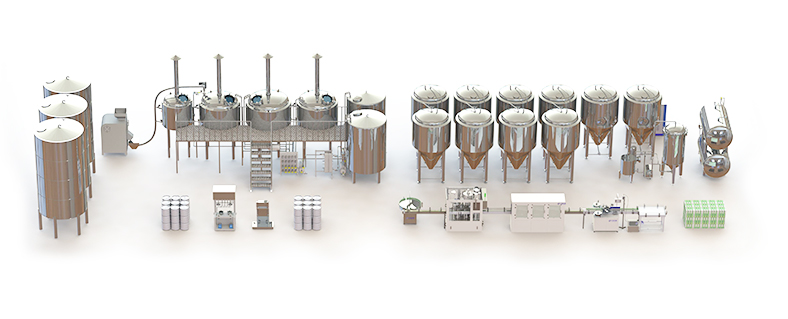
A turn-key brewery project reduces coordination work by designing the brewhouse, cellar, glycol system, utilities, piping, controls, CIP, and packaging around one production plan. A 20 BBL brewhouse running two turns per day can produce 200 BBL of wort in a five-day week, but cellar capacity often sets the real limit: ten 40 BBL fermenters provide only 400 BBL of gross tank volume. In 2024, 9,796 U.S. craft breweries were operating, while craft production fell 3.9%, so new projects need tighter capacity planning rather than oversized equipment. One engineering scope also gives contractors consistent connection requirements, pipe sizes, layouts, and commissioning requirements.
The first engineering task is to convert sales assumptions into vessel occupancy. A brewery targeting 5,000 BBL per year at 85% saleable yield needs to produce roughly 5,880 BBL before losses, not 5,000. At 20 BBL per brew, that is about 294 brews per year, before allowing for maintenance, seasonal peaks, or high-gravity recipes. That production schedule determines whether the brewhouse needs one turn per day, two turns on selected days, or more cellar space instead.
Fermentation time then sets the next limit. If a 20 BBL batch occupies a fermenter for 18 days including fermentation, conditioning, transfer, and cleaning, one 20 BBL tank can complete about 20 cycles in a 365-day year under perfect scheduling. Real plants need cleaning time, yeast handling, dry hopping, quality holds, and unused time between brands. A supplier should therefore model tank days instead of simply matching fermenter volume to brewhouse volume.
A brewery can own enough stainless steel and still miss its production target if tank occupancy, cooling time, packaging hours, and cleaning windows were calculated separately.
Once the cellar plan is known, refrigeration can be sized with better numbers. Brewers Association design guidance published in 2017 notes that refrigeration can be one of a brewery’s largest electrical demands and recommends efficient equipment, variable-speed control where demand changes, automatic refrigeration control, and planned expansion space instead of installing excessive capacity from day one.
Cooling demand changes sharply during production. Holding several fermenters at 68°F requires less cooling than pulling a full vessel from fermentation temperature toward 34°F while other tanks remain active. A supplier can calculate heat removal from beer mass, temperature change, jacket area, ambient temperature, insulation, pump flow, and glycol supply temperature. Adding 30% more chiller capacity without calculating actual peak demand can increase equipment cost, while too little capacity can extend crash-cooling time and delay the next tank cycle.
Water planning follows the same production schedule. The Brewers Association maintains dedicated water and wastewater guidance because brewing, vessel rinsing, CIP, packaging, floor washing, and utility systems all contribute to total consumption. A new plant should map where hot liquor, cold water, recovered water, caustic, acid, and rinse water enter and leave the process. In 2024, when U.S. craft production declined 3.9%, sizing pumps, tanks, and drainage from measured process requirements is more defensible than sizing everything for aggressive growth.
CIP design needs its own calculations because cleaning performance depends on chemical concentration, temperature, contact time, circulation rate, spray-device requirements, return capacity, and pipe geometry. A 30 BBL fermenter may clean normally with a properly selected spray device but perform poorly when the shared return line is undersized or the CIP pump cannot maintain sufficient circulation. Turn-key engineering allows the vessel fittings, CIP cart or skid, pumps, valves, hose stations, and return routing to be checked before fabrication starts.
That same coordination becomes more useful when several utility systems cross the production floor. Wort, finished beer, brewing water, glycol, compressed air, CO₂, steam, condensate, and cleaning chemicals may all require separate routes. A Brewery/Distillery/Winery All-In-One Solution can place the equipment schedule and utility drawings under one process plan, so nozzle locations, valve types, pipe diameters, pump performance, and instrument locations are checked together rather than corrected after installation.
| Area | Common issue with separate purchasing | Turn-key engineering check |
|---|---|---|
| Brewhouse and cellar | More wort than available tank days can handle | Annual BBL, batch count, tank occupancy |
| Glycol | Chiller selected from tank volume only | Peak cooling case, glycol flow, pump sizing |
| CIP | Pump, spray device, and return pipe do not match | Flow, pressure, chemical route, drainage |
| Packaging | Filler capacity exceeds available finished beer | BBL/hour compared with packaging schedule |
| Electrical | Building service is revised late | Connected demand, voltage, motors, control panels |
| Layout | Vessel fits the room but cannot be rigged into position | Door size, ceiling height, access and service clearance |
Layout work should be completed before tanks enter fabrication because installed diameter is only one part of the space requirement. A fermenter also needs top clearance, valve access, sampling access, jacket connections, pressure-relief servicing, removable parts, and a practical rigging route. Brewers Association data for 2025 listed 9,578 U.S. craft breweries, 2.9% fewer than in 2024, so equipment sizing should follow a realistic production plan rather than assuming uninterrupted market expansion.
Controls should then match how operators will actually run the brewery. A small brewpub may use manual product valves with automated tank-temperature control, while a larger production brewery may add PLC sequences, flowmeters, tank-level instruments, actuated valves, recipe steps, and CIP interlocks. In a 2026 project, automation is most useful when it removes repeated operator steps, records temperatures or flow, or prevents conflicting equipment states; automating every valve can increase installation and maintenance cost without increasing annual BBL output.
Safety requirements also affect equipment arrangement. Fermentation and carbonation release CO₂, and OSHA lists a permissible exposure limit of 5,000 ppm as an 8-hour time-weighted average; its annotated table also lists 30,000 ppm as a short-term exposure value. Ventilation, CO₂ detection, tank pressure protection, chemical handling, hot surfaces, platforms, and electrical enclosures should therefore be included while rooms and utility routes are still being designed, not after tanks have been placed.
Factory inspection can remove simpler problems before shipping. Depending on contract scope, checks can cover vessel dimensions, pressure testing, weld condition, internal finish, pump rotation, valve actuation, panel wiring, sensors, and dry control sequences. Site commissioning then adds water circulation, leak checks, temperature verification, glycol balancing, heating tests, CIP circulation, alarm checks, and operator training. A documented punch list also makes responsibility clearer when a 2026 installation includes equipment, controls, refrigeration, and piping supplied under the same contract.
Packaging capacity should be compared with the actual beer schedule rather than the machine’s maximum advertised speed. A canning line rated at 40 cans per minute has a theoretical rate of 2,400 cans per hour, but changeovers, rinsing, dissolved-oxygen checks, label changes, maintenance, and case packing reduce sustained throughput. Brewers Association scan data for 2024 showed that 1-, 4-, 6-, and 12-packs represented 96% of measured craft volume, with 6-packs accounting for 46%, so package mix can materially change line hours and labor requirements.
Expansion can also be prepared without purchasing machinery that may sit underused for several years. The Brewers Association’s 2017 design guidance recommends leaving space, piping connections, and electrical provisions for future refrigeration equipment rather than installing an oversized refrigeration unit that operates at partial capacity. The same method works in the cellar: reserve positions for another 4 or 6 fermenters, install capped glycol branches, leave control-panel I/O capacity, and size selected utility headers for the next planned tank group.
Production economics make that measured approach more relevant. U.S. craft brewers produced 23.1 million barrels in 2024, 3.9% below 2023, while craft retail dollar sales were estimated at $28.8 billion, about 3% higher year over year. The number of operating craft breweries reached 9,796, but 529 breweries closed during 2024 while 430 opened. Equipment capacity therefore needs to be tied to annual volume, beer mix, taproom sales, packaged distribution, available labor, cellar occupancy, and production hours before purchase orders are issued.
A turn-key project can reduce the number of technical handoffs because the brewhouse, fermenters, bright tanks, refrigeration, CIP, piping, controls, and packaging are checked against the same production numbers. For a 10, 20, or 30 BBL brewery, that allows the owner to compare expected annual BBL with tank days, cooling capacity, utility demand, packaging hours, floor area, and future expansion positions before equipment reaches the site. The practical benefit is fewer mismatched interfaces and a shorter path from installed equipment to repeatable production.