Fermentation Capacity: How Many Tanks a Brewery Needs
Tank count is a scheduling question wearing a shopping question's clothes. A brewery that brews twelve times a month does not need twelve fermenters, and a brewery that brews four times does not automatically need four. The number falls out of the brewing cycle, the fill level and the beer styles, and it is worth doing the sum before any order is placed.
Key takeaways
- Fermenter count is batches per month divided by the number of times one tank can turn in that month.
- A 14-day fermentation and conditioning cycle lets a single tank complete roughly two batches a month.
- Lagers, dry-hopped beers and barrel-ageing styles each add hold time and therefore add tanks.
- Add at least one buffer vessel so a stuck fermentation never stops the brewhouse.
The sum starts with the cycle, not the tank list
Every fermenter is occupied for the length of a cycle: fill, fermentation, a diacetyl rest if the style needs one, cooling, and time in tank before packaging. A clean ale cycle of seven days of fermentation and seven days of conditioning occupies a vessel for about fourteen days. At thirty days a month, that is two turns per vessel per month, no matter how large the tank is.
The brewhouse, by contrast, is occupied for a few hours per batch. That asymmetry is the whole problem: the brewhouse can usually brew far more often than one fermenter can accept beer, so fermentation, not mashing, sets the ceiling on output.
Counting fermenters from batches per month
The arithmetic is short. Take the batches you intend to brew in a month and divide by the turns each vessel can complete. Twelve brews a month against a fourteen-day cycle gives 12 divided by 2, which is 6 vessels. Ten brews a month gives 5. Eight brews a month gives 4.
Then add buffer capacity. A single spare or buffer vessel absorbs the two events that always happen: a fermentation that slows down, and a packaging day that slips. One extra vessel is the difference between a plan and a schedule that survives contact with real yeast.
Fractional answers round up, never down. Eleven brews a month against a fourteen-day cycle gives 5.5, and the honest answer is 6 vessels plus the buffer, because a half-full tank still ties up a full tank's worth of floor space, glycol and cleaning time.
Styles change the count more than tank size does
A lager at eight weeks from pitch to package occupies its vessel for four turns' worth of ale production. A dry-hopped IPA may need a second vessel for the hop addition, or at least extra hold time after the dry hop. A barrel or mixed-fermentation programme can take a tank out of circulation for months.
The practical rule for a mixed portfolio is to plan the flagship ale at full turns and then adjust the tank count downwards by the share of production in slow styles. A brewery balancing seventy per cent quick ales and thirty per cent lagers cannot budget for the ale-only figure; a rule of thumb on this example is to add one vessel for every thirty percentage points of slow-style volume.
Small vessels are also the least costly way to keep the count sensible. A supplier whose range includes 200 litre nano sets, 300 and 500 litre microbrewery kits and units up to 10,000 litres gives a brewery room to add a small tank for a seasonal rather than a large tank that sits empty for half the year. The micro brewery equipment listing sets out those sizes side by side.
| Plant size | Brews a month | Cycle | Vessels needed |
|---|---|---|---|
| 300 L microbrewery | 8 | 14 days | 4 plus 1 buffer |
| 500 L microbrewery | 10 | 14 days | 5 plus 1 buffer |
| 1,000 L two-vessel | 12 | 14 days | 6 plus 1 buffer |
| 1,000 L two-vessel | 16 | 14 days | 8 plus 1 buffer |
| 2,000 L three-vessel | 16 | 21 days for lagers | 11 plus buffer |
Turning the tank count into annual output
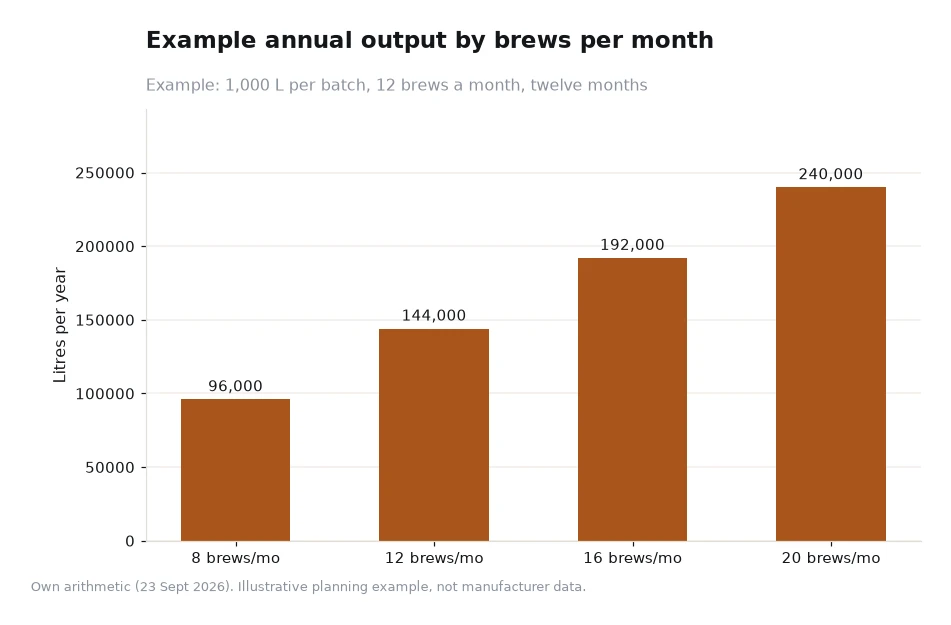
Once the count is settled, the annual figure follows from the batch size and the brewing rate. The chart below shows an example at 1,000 litres per batch: eight brews a month produce 96,000 litres in a year, twelve brews produce 144,000, sixteen produce 192,000 and twenty produce 240,000. Each step of four brews a month adds 48,000 litres of throughput, which is exactly the extra tank capacity that step demands.
Worked example: seven vessels for a 1,000 litre house
Assume a 1,000 litre brewhouse, twelve brews a month, a fourteen-day cycle from pitching to packaging, and a working fill of 85 per cent. Each vessel turns twice a month, so the base requirement is 12 divided by 2, which is 6 fermenters. Add one buffer vessel and the order is seven 1,000 litre tanks with about 7,000 litres of installed fermenter volume.
Each brew yields 850 litres of saleable beer after allowing for the headspace, so twelve brews give 10,200 litres a month. Over twelve months that is 122,400 litres of packaged beer, below the 144,000 litres on the chart because the chart assumes the full 1,000 litres per batch with no fill allowance. If the target really is 144,000 litres a year, the brewhouse either needs fifteen brews a month at 850 litres or a larger batch size.
Push the plan to sixteen brews a month and the tank sum changes again: 16 divided by 2 gives 8 vessels, plus the buffer makes 9, with 192,000 litres a year at full batch size. That is the point where many breweries stop adding tanks and start asking about larger vessels, because nine tanks need floor space, glycol capacity and cleaning time that a single 2,000 litre unit does not.
Frequently asked questions
Can I ferment in a tank that is only half full?
A half-full tank works if the jacket still covers the liquid and the temperature probe sits in the beer rather than in the headspace. It wastes capacity, and a shallow liquid level makes cooling less even, so it is better as an occasional seasonal arrangement than as the normal way of running the plant.
Should the buffer vessel be the same size as the others?
A matching buffer vessel keeps spare parts, gaskets and fittings common across the whole set, which simplifies maintenance. A smaller buffer can hold a split batch or a trial brew and costs less floor space. Most breweries choose one tank of the same size and accept that it is sometimes empty.
Plan the count before you plan the order
Write the tank schedule out as a month-by-month table before requesting a quotation: batches per month, cycle length per style, turns per vessel, buffers. A supplier can then quote a set that matches the schedule instead of guessing from a batch size. Hermann publishes its vessel range from 200 litres up to 10,000 litres, so the sizes needed for most of these scenarios already exist in the catalogue; the brewhouse listings show how the vessels pair with the mash and kettle side.
Two documents are worth requesting with any tank order: the inspection record that travels with the shipment, and the data plate details for each vessel. The published warranty covers tank accessories and electronic components for 6 years against manufacturing defects from the factory when used within scope, and keeping serial numbers with the order file makes any later claim or matching expansion straightforward. If the schedule is still uncertain, a short call with the sales and engineering desk, reachable through the contact page, usually settles the count in one pass rather than three.
Figures in this article come from the manufacturer's own website, read 23 Sept 2026, including the published vessel size range and the 6-year warranty wording; the tank counts, fill allowances and annual volumes are this article's own arithmetic with assumptions stated in the text. Details: [1]