Building Continuity: Memories in Adult AI Chat
A stored memory is an instruction that outlives the conversation that created it. When you note a preference, a tone or a detail, later sessions start from that fact instead of rediscovering it, which is why a companion with a maintained memory feels less like a stranger each time. The platform gives that idea its own place in the navigation, beside Characters and Creators.

Key takeaways
- Store facts, not scenes: durable preferences survive a rewrite, one-off moments do not.
- Three or four notes are enough to change how a later conversation opens.
- Review the notes whenever a thread is abandoned, or stale information will keep steering new sessions.
- Continuity only pays if the thread is kept: 28 sessions across six weeks is a relationship, not 28 experiments.
How a stored memory changes a later conversation
The effect is easiest to see at the start of a session. Without stored memory, the first three or four messages are spent establishing what you want, and the companion's opening is written for a general reader. With it, the opening arrives already tuned to the tone you prefer and the details you established weeks ago.
The second effect appears in the middle of a conversation. A memory that records how you like a slow exchange handled lets the companion pace itself without being told again, which is what most readers mean when they say a character feels consistent. Consistency is not personality; it is memory applied to previous decisions.
The third effect is cumulative and slightly awkward to admit: a maintained memory makes you a more predictable reader, and predictability is what allows a companion to be more specific. The better the stored facts, the less generic the replies have to be.
What belongs in a memory, and what belongs in a thread
Store durable facts: how you prefer an exchange to be paced, a tone you return to, a detail the character should always know, a line you never want crossed. Those are things a future session should inherit whatever the conversation happens to be about, and they are the notes that earn their place.
Leave scenes in the thread. A specific evening's storyline, a one-off direction, a joke that only worked in context - those belong to the conversation that produced them, and promoting them to a memory makes every future session reference something that no longer applies. Storage is selective for a reason.
Name things concretely. A note that says the tone should be 'warm and unhurried' is more usable than one that says 'good vibes', because the first can be matched and the second has to be interpreted. Concrete notes also make review easy: if a note no longer describes what you want, it is an obvious removal.
| Item | Store it or not | Check before keeping |
|---|---|---|
| Preferred pace and tone | Store | Does it still describe what I want? |
| Terms and limits | Store | Is it stated in plain, concrete words? |
| A one-off storyline | Leave in the thread | Would it still make sense next month? |
| A character's established backstory | Store briefly | Does the thread already carry it? |
| Session-specific jokes | Leave in the thread | Does it land without the original context? |
The third column is the whole discipline. Notes that fail it are the ones that quietly damage later sessions, because a companion acting on an obsolete instruction is doing exactly what it was told.
Worked example: memory compounding over six weeks
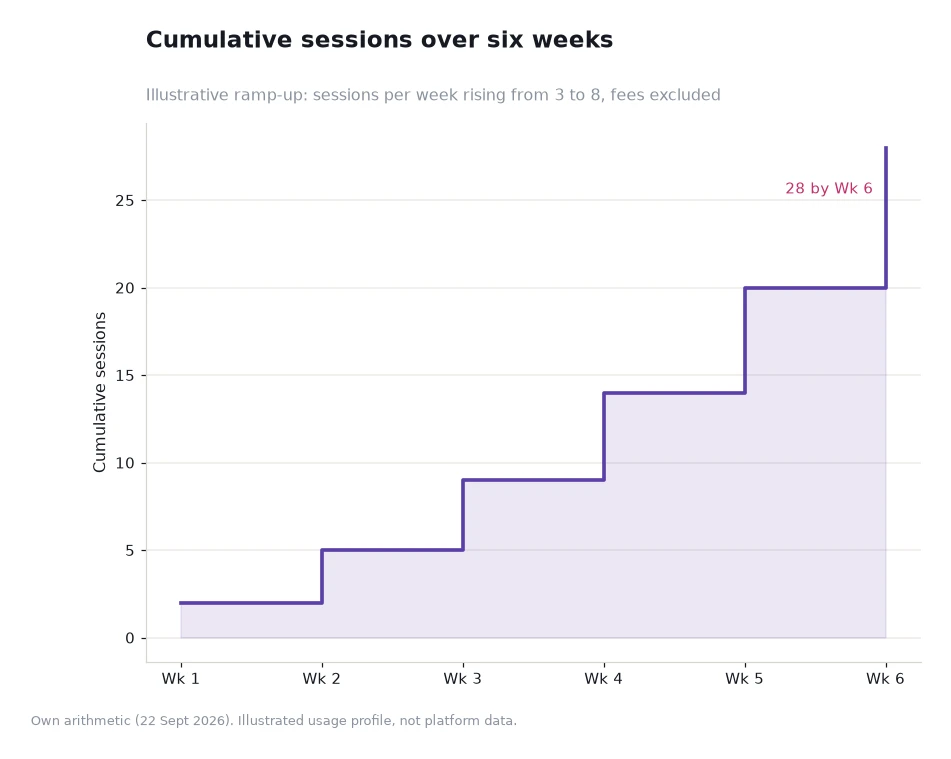
Take an illustrative ramp in which weekly sessions grow: 2, then 5, 9, 14, 20 and 28 cumulative sessions by the end of week six, with weekly additions of 2, 3, 4, 5, 6 and 8. If a session runs about 40 messages, the six-week total is 28 multiplied by 40, which is 1,120 messages - roughly 187 a month.
Now compare two readers with that same habit. The first keeps one thread and four stored memories. By week six the thread carries more than a thousand messages of context and the notes handle everything that matters beyond it. The second opens a fresh conversation each time; 28 sessions produce 28 threads of about 40 messages each, and the stored notes are the only thing that crosses between them.
The difference is measurable in restatement alone. Four notes replace perhaps four sentences of setup per session, which over 28 sessions is about 112 messages of pure repetition avoided - around ten percent of the month's volume, spent on conversation instead of reintroduction.
There is a second saving that the arithmetic only hints at. A note is written once and applied in every later session for as long as you keep it, so the cost of writing it is spread across dozens of conversations, while the cost of restating a preference is paid every single time. Ten words written once against four sentences repeated 28 times is the whole case for spending two minutes on notes rather than none.
Phrasing decides how much of that saving you collect. Write notes as instructions rather than impressions: an instruction such as keeping the pace slow and the register warm can be followed directly, while an impression such as something calmer invites interpretation. The test is whether a stranger reading the note could act on it, and if the answer is no, the note needs a second pass.
Keeping the notes honest
Review the stored notes on the same day you prune your saved characters, and treat the two tasks as one. Anything you no longer want applied should go, and anything new that has become a reliable preference should be added. Two minutes a fortnight is enough to keep a memory useful rather than merely large.
The platform describes its companions as characters that recall previous interactions and adapt over time, so the mechanism is designed to be fed. A reader who wants the full picture of how that works in practice, rather than a summary, can read the platform's own description of sex ai chat and the wider framing around Sex AI companions before deciding what to store. The catalogue is the other half of the picture: a character whose first session already suits you needs fewer notes, so character search does part of the work that memory would otherwise have to do.
The habit is small and the payoff is cumulative: a handful of well-written notes, applied consistently, do more for how a month of conversations feels than any amount of tuning the opening message.
Frequently asked questions
How many memories should I store?
Three or four is usually enough. Beyond that you are describing a person rather than a preference, and the notes become harder to keep accurate.
Do memories replace a long thread?
No. They carry the durable facts across sessions, while the thread carries the specifics of what happened. Both do different work.
What happens if a stored memory becomes wrong?
Later conversations keep acting on it. That is why a short review every fortnight is part of the method rather than an optional extra.
Write four notes and keep them current
Open the memories section once and add three or four concrete facts about how you like a conversation to run. Keep the thread that produced them, review the notes fortnightly, and remove anything that has stopped being true. Continuity is the cheapest quality upgrade in the category and it starts with a sentence.
Sources: navigation labels, the memory and adaptation wording and the trend-card counters referenced here were read from Crushon on 22 Sept 2026; the six-week totals and the 112-message estimate are illustrative arithmetic rather than platform data.[1] This piece is written for an 18+ readership.